
Guardsman Air Duct Cleaning in University Park: A Homeowner’s Guide
Most duct cleaning companies treat every system the same way. That’s fine for standard sheet metal – and a potential problem for Guardsman flex-duct configurations where improper brush pressure can compromise the inner liner. A flexible duct is not a metal pipe with a different bend radius. The liner is a thin layer, the joints are mechanically fastened, and the wrong equipment can leave a system more damaged than it started. If you’re searching for Guardsman air duct cleaning in University Park, the most useful thing we can give you is a checklist of what to ask before anyone puts equipment in your ductwork. If you’d rather not sort through it alone, call (866) 947-8605.
What Makes a Guardsman Duct System Different From Standard Sheet Metal?
Guardsman flex duct is a layered product, not a single material. Inside the outer vapor barrier sits a helical wire core, and inside that is a thin inner liner that carries the airflow. On standard sheet metal, an aggressive brush hits a rigid wall and bounces off. On flex, the same brush can abrade the liner, tear it at a joint, or pull the core out of the collar where the run connects to the plenum.
That difference matters most in University Park homes built in the decades when flex duct became the norm for branching runs – the trunk lines may be sheet metal while the branches to individual rooms are flex. A cleaner who starts a rotary brush through the trunk without stopping at each branch can drive debris into the branches instead of out of the system.
Three construction types you’ll find in University Park, and where the risk sits:
- Sheet metal: Rigid, forgiving, safe for mechanical agitation. Debris sits as dust on flat surfaces and is removed easily.
- Fiberglass board: A rigid board with a coated interior face. The coating can chip if abraded, and once chipped, fibers are exposed to airflow.
- Guardsman flex: A thin inner liner over a wire helix. Abrasion here is the main failure mode, and liner damage is not always visible from a supply register.
That last point is the one many University Park homeowners never hear. A compromised liner doesn’t announce itself. It shows up later as a slight performance drop, a whistle at a register, or insulation fibers collecting on the back of a return grille.
Why Suction-Only Negative Pressure Is Often Safer for Guardsman Flex Sections
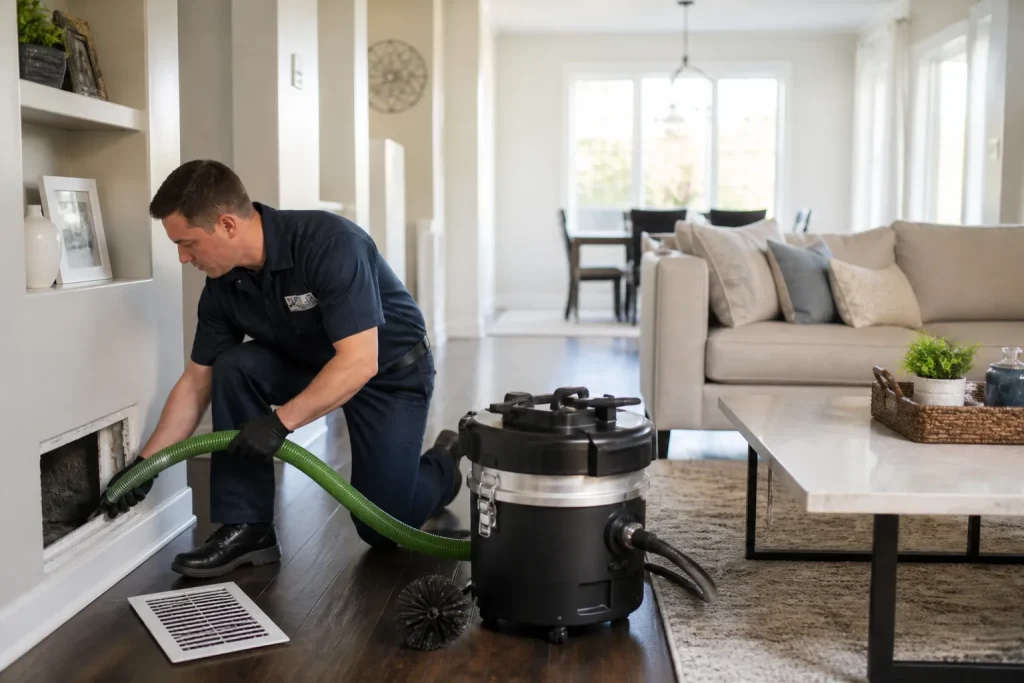
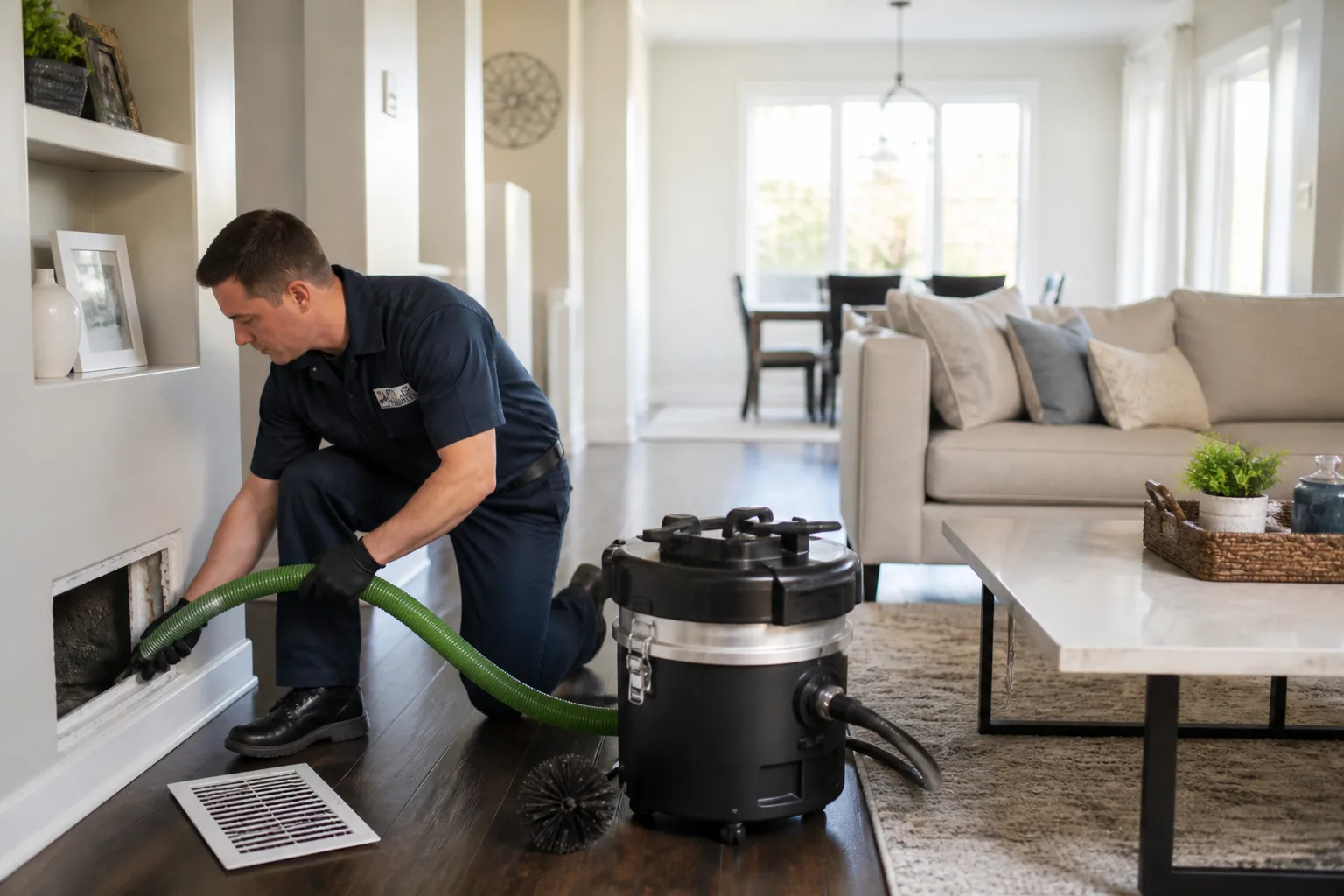
Suction-only cleaning pulls contaminants out under negative pressure instead of scrubbing them loose. On flex duct, that’s usually the safer first method. Rather than pushing a spinning brush through a thin liner, the technician seals the system, establishes negative pressure at a collection point, and lets air movement lift the debris toward the vacuum source. The liner stays untouched.
This is where equipment choice is not a marketing detail. Our technicians use Abatement Technologies equipment on the job, which is built around HEPA filtration and controlled negative air pressure – the same approach used on mold and contaminant abatement projects. When we set up on a University Park home with Guardsman flex, the goal is to hold that pressure steady so the liner is loaded with airflow, not friction.
Where rotary agitation does earn its place is on rigid sections – sheet metal trunks, plenum boxes, and returns. We run Rotobrush and Nikro systems for those runs, which is the same class of equipment commercial HVAC contractors rely on. On a mixed system, the practical answer is a hybrid: mechanical agitation where the duct can take it, negative pressure where it can’t.
What you should hear from any company in University Park before work begins: a clear statement of which runs they’ll brush, which runs they’ll clean by suction only, and why. If the answer is “we brush everything,” that’s a reason to ask more questions. Learn more about how we approach air duct cleaning in University Park.
How Do You Verify a Technician Understands Flex-Duct Liner Integrity?
Ask about method before the appointment, not when the vacuum is already in the driveway. A technician who works with Guardsman systems regularly will answer these without hesitation:
- How do you decide which runs get brushed? Expect a reference to duct material and condition, plus a visual inspection first.
- What do you do if you find a torn liner? A specialist stops and reports it. Flex liner damage can sometimes be repaired; a run that’s too far gone gets replaced. Confirm the company can handle both.
- Do you seal and reattach joints after cleaning? Disturbed connections are a common source of later leakage and should be resealed the same visit.
- What equipment are you bringing? Named professional platforms – Rotobrush, Nikro, Abatement Technologies – tell you the company is set up for more than a shop vacuum and a hose.
- Will I see photos of my own ducts before and after? A technician with nothing to hide will happily show you.
Our technicians have up to 10 years of experience with mixed duct systems, and it shows in the questions they ask before touching a single register. One more: ask whether the crew handles HVAC cleaning – the air handler and coil – at the same time, because debris in the ducts and debris on the coil are usually the same problem seen from two sides.
Is Your Guardsman System Due for Cleaning, Repair, or Replacement?
Not every dirty duct needs cleaning, and not every “dirty” system needs the same answer. In University Park, where mild winters keep HVAC systems running for much of the year, the signs tend to show up gradually. Here’s how to read them.
- Consistent dust on supply registers right after cleaning: often a cleaning gap, not a failure – the return side was skipped.
- Visible dust streaks on the flex exterior near a joint: a loose connection pulling air from unconditioned space. Repair and sealing first.
- Whistling or weakened airflow at one register: a kinked or collapsed flex run. This is a repair, not a cleaning.
- Fibers or grey fuzz collecting on return grilles: possible liner breakdown. Inspect before you clean.
- Musty smell when the system starts: often moisture, which points toward sanitizing and repair rather than a standard clean.
“Clean ducts are only half the job” is a line we use because we mean it. University Park Air Duct Cleaning Co handles the full scope – cleaning, mechanical repair, and sealing – so a compromised joint is fixed in the same visit rather than flagged for someone else. And if you’re noticing lint building up behind the dryer, that’s a separate safety issue: dryer vent cleaning is one of our five core services for exactly that reason.
Questions to Ask Any University Park Duct Cleaning Company About Flex-Duct Preservation
Put these in a note before you make the call. The answers separate a specialist from a generalist, and they give you a fair basis for comparison.
- Do you inspect duct material before choosing a cleaning method?
- Will you use suction-only negative pressure on flex runs and agitation only on rigid ones?
- Do you carry Abatement Technologies equipment, or a comparable HEPA and negative-air setup?
- If you find liner damage, do you stop and tell me before continuing?
- Can you repair or reseal a joint during the same visit, or do I need a second company?
- Will I get photos of my own ducts before and after, not stock images?
- Does the price hold once work begins, or can it change mid-job?
- How do you prevent pushing debris from the trunk into the branches?
Then ask the one that matters most to most University Park homeowners: is the price one figure per system, agreed before work starts? Per-vent pricing and teaser coupons are where most duct cleaning complaints begin. Our answer is one flat price per system, set by a written estimate, so the number doesn’t move once the equipment is on the ground.
When to Call a Pro Instead of Continuing to Investigate
Some checks are yours to make. Others aren’t. Visual inspection of registers, filter changes, and noting where airflow feels weak – those you can do. Confirming liner integrity inside a flex run, testing joint seals, inspecting the air handler, and handling anything involving the electrical components inside the HVAC cabinet is work for a trained professional. Liner damage can involve exposure to insulation fibers, and electrical issues inside the cabinet are a safety matter, not a DIY one. If your system shares space with a gas furnace, leave gas-line work and combustion-side inspection to a qualified technician.
Our technicians have up to 10 years of experience, and the reason we start every job with a visual inspection is simple: it’s the only way to know what we’re cleaning before we clean it. If your Guardsman system shows any of the signs above, or if the ducts haven’t been inspected since a renovation or a home inspection flagged them, that’s the moment to bring in a specialist.
The Bottom Line
Guardsman ductwork needs a method matched to its materials, not a one-size brush-through. Safe cleaning starts with visual inspection, moves to suction-only negative pressure on flexible runs, and reserves mechanical agitation – with Rotobrush or Nikro systems – for rigid sections that can take it. Abatement Technologies equipment keeps the air contained while the work happens. If you’re comparing companies in University Park, ask about liner preservation, joint sealing, and whether the price is one flat figure per system agreed before work begins.
If you’re in University Park and need help, University Park Air Duct Cleaning Co offers free estimates – call (866) 947-8605. We answer 24/7. Fast dispatch from 7am to 7pm. Our team also installs Honeywell and Aprilaire air quality products and Guardsman-grade sanitizing treatments when the inspection calls for them, so a repair, a reseal, and a filter upgrade can happen in one visit.
Frequently Asked Questions
Usually not at full brush pressure. Guardsman flex carries a thin inner liner that can abrade or tear under aggressive rotary agitation. Suction-only negative pressure is the safer first method on flex runs, with mechanical agitation reserved for rigid trunk lines and plenums after a visual inspection.
Look at the registers. Dust returning soon after a cleaning usually points to a missed return side, while whistling, weak airflow at one room, or fibers on the return grille point to liner damage or a loose joint – which is repair work, not cleaning. A visual inspection before the job confirms which one you have.
Low quotes often reflect a suction-only pass with no joint sealing, no liner inspection, and per-vent pricing that grows once the technician is on site. Ask what’s included, whether joints get resealed, and whether the price is one flat figure per system agreed before work starts.
Yes – and it’s the better option. Splitting cleaning and repair across two companies means a compromised joint may sit open between visits. Ask ahead whether the crew handles the full scope, including mechanical repair, sealing, and sanitizing such as Guardsman-grade treatments. Call (866) 947-8605 for an exact quote on your system.
Written by the team at University Park Air Duct Cleaning Co.
Need Air Duct Cleaning Help?
Call University Park Air Duct Cleaning Co - the local pro we connect you with is licensed and insured, with free written estimates in University Park.
(866) 947-8605